MIAMI, FL, May 19th, 2026 – Self-driving food delivery robots are no longer a futuristic idea in Miami. They are already rolling through neighborhoods like Brickell, Miami Beach, Wynwood, Coconut Grove, Little Havana, and parts of Downtown, carrying pizza, burgers, Mediterranean bowls, and takeout orders across sidewalks.
For some Miami residents, the robots are cute, convenient, and a sign that the city is becoming a testing ground for new technology. For others, they are one more thing competing for space on already busy sidewalks.
Either way, Miami is learning how to live with them.
A new kind of delivery driver
In 2025, Serve Robotics expanded into the Miami metro area through a partnership with Uber Eats. The robots are being used for short-distance “last mile” deliveries from participating restaurants, including Shake Shack and Mister O1 locations in Brickell and Miami Beach.
Unlike traditional food delivery, these robots do not drive on the road. They travel on sidewalks, carry food in an insulated compartment, and use cameras, sensors, GPS, AI, and 360-degree laser imaging to navigate the city. In more complicated situations, such as busy intersections, they can receive help from remote human operators.
Axios reported that Serve’s robots can travel up to 11 mph and carry up to 15 gallons of food, which is about the equivalent of four 16-inch pizzas. CBS Miami reported that they typically move at 3 to 5 mph on sidewalks and generally deliver within a short radius from the restaurant.
For customers, the process feels familiar. They order through an app like Uber Eats. If robot delivery is available, they may be matched with a robot. Once the robot arrives, the customer receives a phone notification and unlocks the compartment to retrieve the food.
Why Miami is becoming a robot delivery test market
Miami makes sense for this kind of technology. It has dense neighborhoods, lots of restaurants, heavy delivery demand, warm weather, and a public image as a city open to innovation.
This is not the first time robots have appeared on Miami sidewalks. Tiny Mile tested its small pink robots in Downtown Miami, Overtown, East Little Havana, and Brickell in 2023. Axios noted that Miami has become a testing ground for autonomous technology, including robot delivery and driverless vehicle pilots.
Kiwibot has also operated in Miami, and other companies have used the city to test different versions of sidewalk-based delivery. Refresh Miami described Miami as a place where multiple robot delivery companies have been learning how to navigate busy streets, scooters, pedestrians, and dense urban neighborhoods.
The basic idea is simple: many food orders are short trips. Supporters argue that it does not always make sense to use a car or a full-size delivery vehicle to move a small meal a few blocks. Serve Robotics has framed the issue with the question, “Why deliver 2-pound burritos in 2-ton cars?”
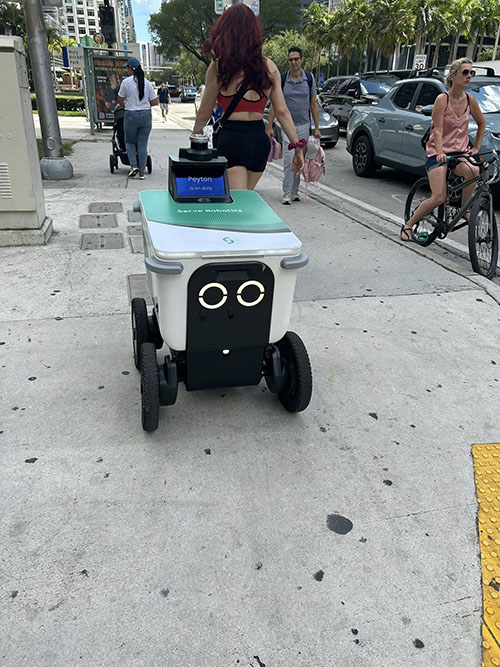
Miami residents are curious, amused, and sometimes annoyed
The public reaction has been mixed.
Some people stop to take photos. Children run up to the robots. Residents notice their cartoon-like design and treat them almost like characters moving through the neighborhood. In Coconut Grove, Serve Robotics said the robots are intentionally designed to look cute and approachable, and people sometimes contact the company when they think a robot is in trouble.
Other residents are less enthusiastic. CBS Miami interviewed people who described the robots as annoying or inconvenient, while others said they preferred robots over having more bicycle delivery riders crowding the streets.
That divide captures Miami’s adjustment period. People are not just reacting to the robot itself. They are reacting to what it represents: more technology in public space, more delivery traffic, and more questions about who has the right of way on crowded sidewalks.
In areas like Brickell, Miami Beach, and Coconut Grove, sidewalk space is already shared by pedestrians, tourists, scooters, bikes, strollers, dogs, restaurant patios, and delivery workers. A slow-moving robot may seem harmless, but it still changes how people move through the city.
Restaurants are learning how to work with robots too
The adjustment is not only happening on the customer side. Restaurants also have to adapt.
In Coconut Grove, the manager of Sushi Maki told Coconut Grove Spotlight that the first robot pickup created a small logistical problem because the robot could not go up the stairs. Staff had to bring the food to a nearby location where the robot could access it. After several more robot interactions, the manager said there had been no customer complaints and joked that the robots are more patient than human delivery drivers.
That is a small but important example of how automation works in the real world. Robots may be smart, but they still depend on human-friendly environments. Stairs, narrow sidewalks, construction zones, blocked curb cuts, and busy intersections can all create problems.
For restaurants, the appeal is clear. Robot delivery may help fulfill more short-distance orders and reduce friction for customers who do not want to pay higher delivery fees or tips. CBS Miami reported that Rice Mediterranean said robot deliveries had boosted its business substantially, with the general manager citing more than 100 daily orders.
The biggest concerns: sidewalks, safety, and jobs
The three biggest concerns around food delivery robots in Miami are sidewalk congestion, safety, and the future of delivery jobs.
Sidewalk congestion is the most visible issue. Even when robots move slowly, they still take up physical space. Residents who already deal with crowded sidewalks may see them as another obstacle.
Safety is another concern. The robots are designed to detect obstacles and avoid people, but Miami is a complex environment. Drivers, scooters, pedestrians, tourists, construction crews, and unpredictable street conditions make autonomous navigation more difficult than a controlled campus setting.
The job question is more complicated. Some people worry that robots will replace human delivery workers. Serve Robotics argues that robots may actually increase demand for delivery by making short-distance orders cheaper. The company has also said that humans are still needed to maintain, clean, supervise, and support the robots.
The likely reality is mixed. Robots may take over some short, simple trips. Human couriers may continue to handle longer, more complex, or higher-touch deliveries.
Miami is adapting in real time
What makes this trend interesting is not just the technology. It is the way Miami is adapting to it in public.
People are learning to walk around robots. Restaurants are learning where to place orders for pickup. Customers are learning how to unlock their meals. City officials are learning how these devices fit into sidewalk rules, pedestrian safety, and transportation policy.
The robots are also becoming part of the city’s visual landscape. Like scooters, rideshare cars, delivery bikes, and mobile ordering before them, they may feel strange at first and normal later.
Miami’s response shows both sides of living in a fast-changing city. People want convenience, lower costs, and new technology. They also want sidewalks that feel safe, accessible, and human.
Self-driving food delivery robots are not taking over Miami overnight. But they are no longer a novelty either. They are here, they are expanding, and the city is figuring out how to share space with them one delivery at a time.